
Resting energy needs
Understand the energy your body expends at rest through measurement rather than a population-based prediction.
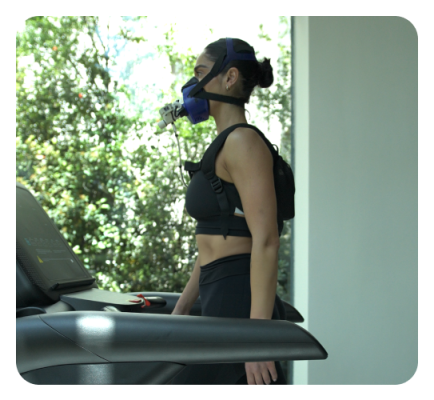
See how your body uses oxygen, produces energy and shifts between fuels—then translate that respiratory data into a more informed starting point for nutrition, training and your Longevity Gyms Circuit.
PNOĒ uses indirect calorimetry: you breathe through a fitted mask while the system measures oxygen consumption and carbon-dioxide production. Those gases reveal how your body is meeting its energy demands at rest and as workload changes.
The value is not simply collecting more numbers. It is bringing multiple metabolic signals into one interpretable view so your starting plan can reflect your actual physiology rather than generalized calorie equations or age-based training formulas.
Understand the energy your body expends at rest through measurement rather than a population-based prediction.
See the relative contribution of fat and carbohydrate to energy production under the conditions measured.
Evaluate how oxygen use and energy demand change as exercise intensity rises.
Identify meaningful shifts in your respiratory response that can help inform individualized training intensity.
Place energy expenditure, fuel selection and exercise response into a more complete functional context.
Use your results with your goals, history and other assessments to guide the next phase of your plan.
The exact outputs available depend on the testing protocol completed. Your team will identify which assessment—or combination of assessments—fits the question you are trying to answer.
A progressive exercise assessment focused on maximal oxygen use, ventilatory thresholds and training zones.
A quiet, resting assessment used to measure baseline energy expenditure and resting fuel utilization.
A broader interpretation of respiratory data designed to turn measured physiology into useful training, nutrition and lifestyle context.
PNOĒ can be useful when generic calculators, wearable estimates and one-size-fits-all recommendations are not enough. The goal is to establish a clearer metabolic baseline and use it to ask better questions about training, energy intake and progress.
Collect direct respiratory data using the protocol that matches the question and your current capacity.
Use the findings with your goals and other assessments to inform nutrition, training and service selection.
Repeat the relevant assessment after an appropriate interval to determine what has actually changed.
No. PNOĒ is a metabolic-analysis system that can measure respiratory data during different protocols. VO₂ Max is a specific maximal-exercise assessment. If your goal requires VO₂ Max, the exercise protocol must be performed rather than inferred from a resting test.
Not exactly. Resting metabolic rate is one specific measurement performed at rest. PNOĒ may be used to conduct and interpret that assessment, but its analysis can extend to exercise-related metabolic data when the appropriate protocol is completed.
That depends on the assessment selected. A resting protocol is performed quietly, while an active protocol involves controlled exercise. We will match the testing format to your goal and screening results.
Preparation depends on the protocol. You may be asked to avoid food, caffeine, nicotine and strenuous exercise for a defined period beforehand. Follow the instructions from our team because preparation can materially affect metabolic measurements.
Your results can inform nutrition and training decisions, but the exact deliverable depends on the service you book and the professionals involved. Testing data is not automatically a medical nutrition plan or a diagnosis.
The right interval depends on your goal, the changes you are making and which measurement you want to track. We establish a retesting point only after allowing enough time for a meaningful response.
Tell us what you want to improve. We will help determine which PNOĒ protocol—and which supporting assessments—belong at your starting point.
Start Your Upgrade →PNOĒ metabolic testing is an assessment and educational service, not a diagnosis or treatment. Available measurements depend on the protocol performed. Participation is subject to appropriate screening, and individual results vary.