

Therapeutic PlasmaExchange.
Your cells live in a fluid. Plasma exchange removes that fluid and replaces it. Everything cellular stays with you. This page explains exactly how that works, and exactly how strong the evidence is.
Blood is two things. This addresses one of them.
Roughly half of your blood volume is cells. The other half is plasma, a straw coloured fluid carrying proteins, antibodies, lipids, hormones, clotting factors, inflammatory signals, and whatever else has entered circulation and not yet left.
Therapeutic plasma exchange separates those two halves by centrifugation. The cells go back into you. The plasma is discarded and replaced, most commonly with human albumin solution, sometimes with donor plasma depending on the clinical picture.
That is the whole mechanism. It is not filtration, it is not a cleanse, and it does nothing to your organs directly. It changes the composition of the fluid your cells are sitting in, and everything that follows is downstream of that single change.
 Plasma out, albumin in
Cells returned to you
What actually happens to your blood.
Scroll to follow a single pass through the machine, layer by layer.
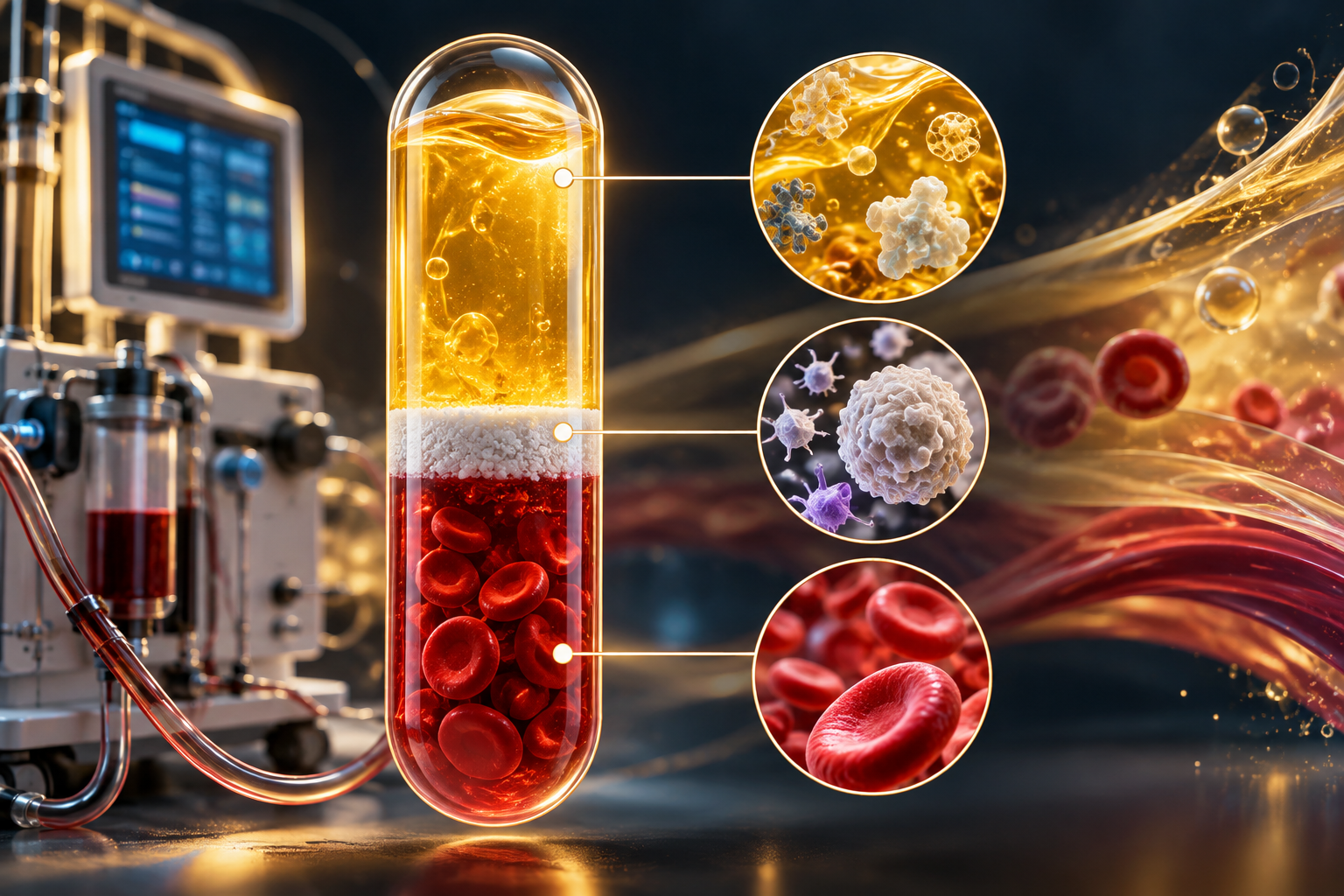
Spun, then layered by density.
Blood is drawn into the Spectra Optia and spun continuously. Centrifugal force layers it by density, lightest at the top and densest at the bottom, while optical detection holds the boundary between the layers in place.
Spectra OptiaThe fluid your cells sit in.
The straw coloured liquid carrying proteins, antibodies, lipids, hormones, clotting factors and inflammatory signals. This is the only layer that leaves.
RemovedA thin band in the middle.
A thin pale band of white cells and platelets, called the buffy coat, sitting between the plasma and the red cells. It goes back into you.
ReturnedThe densest layer settles last.
The densest layer, the cells that carry oxygen. Returned to you continuously, together with the replacement fluid.
ReturnedOnly the plasma leaves.
The plasma is discarded and replaced, most commonly with human albumin solution. Every cell goes back into you. That single change in the fluid is the whole procedure.
Separation
Blood is drawn into the Spectra Optia and spun continuously. Centrifugal force layers it by density, lightest at the top and densest at the bottom, while optical detection holds the boundary between the layers in place.
Plasma, about 55%, removed
The straw coloured liquid carrying proteins, antibodies, lipids, hormones, clotting factors and inflammatory signals. This is the only layer that leaves. The plasma is discarded and replaced, most commonly with human albumin solution. Every cell goes back into you. That single change in the fluid is the whole procedure.
White cells and platelets, under 1%, returned
A thin pale band of white cells and platelets, called the buffy coat, sitting between the plasma and the red cells. It goes back into you.
Red cells, about 45%, returned
The densest layer, the cells that carry oxygen. Returned to you continuously, together with the replacement fluid.
Separation by density, which is the only thing centrifugation does.
Dr. Bajnath on what plasma exchange actually does.
The mechanism in plain terms, what the current research supports, and where the honest limits are. Watch this before your consultation and the conversation gets shorter and better.
Anil Bajnath, MD · Institute for Human Optimization
A closed loop, running the whole time.
Blood leaves, separates, and returns continuously rather than in batches. Only one thing does not come back to you.
Follow one pass Through the machine.
Scroll to follow a single loop of blood through the Spectra Optia, part by part.
Whole blood out Into the circuit.
Blood leaves through venous access and enters the disposable tubing set, continuously rather than in batches.
Separated by density Inside the cabinet.
The centrifuge spins the blood. Denser red cells move outward, plasma stays innermost, and optical detection holds the boundary between them.
Plasma diverted And discarded.
The plasma layer is drawn off into a collection bag. It is the only part of your blood that does not come back.
Replacement fluid in Human albumin.
Albumin solution is added to replace the volume removed, so fluid balance stays steady through the run.
Cells returned To you.
Red cells, white cells and platelets go back together with the replacement fluid. The loop keeps running until the planned volume has been exchanged.
Two very different questions.
Whether plasma exchange works is not one question. It is two, and they have very different answers. Conflating them is how this procedure gets oversold, so we separate them here.
Plasma exchange as a clinical procedure
- In continuous clinical use since the 1960s, with the first documented therapeutic application in 1963
- The American Society for Apheresis maintains graded indication categories reviewed and republished on a defined cycle
- First line standard of care for a defined set of neurologic, hematologic, and autoimmune conditions
- Safety profile characterised across decades of hospital use, with reactions well described and generally manageable
- Performed on equipment cleared for the purpose and operated by trained personnel
Plasma exchange for age related reasons
- No trial has shown that plasma exchange extends lifespan or reduces disease incidence in healthy adults
- Published results rest on epigenetic age estimates, which are statistical models built from methylation data rather than measured health outcomes
- The trial base is small, recent, and in the key case single blind rather than double blind
- Optimal frequency, total number of sessions, and durability of any effect are all unknown
- Long term safety data in healthy adults undergoing repeated exchange does not yet exist
The 2025 trial was single blind, small, and measured epigenetic age estimates rather than clinical outcomes. It was supported by Circulate, Inc.; Kiprov, Verdin, and Furman are members of Circulate, and Furman is a founder of Edifice Health.
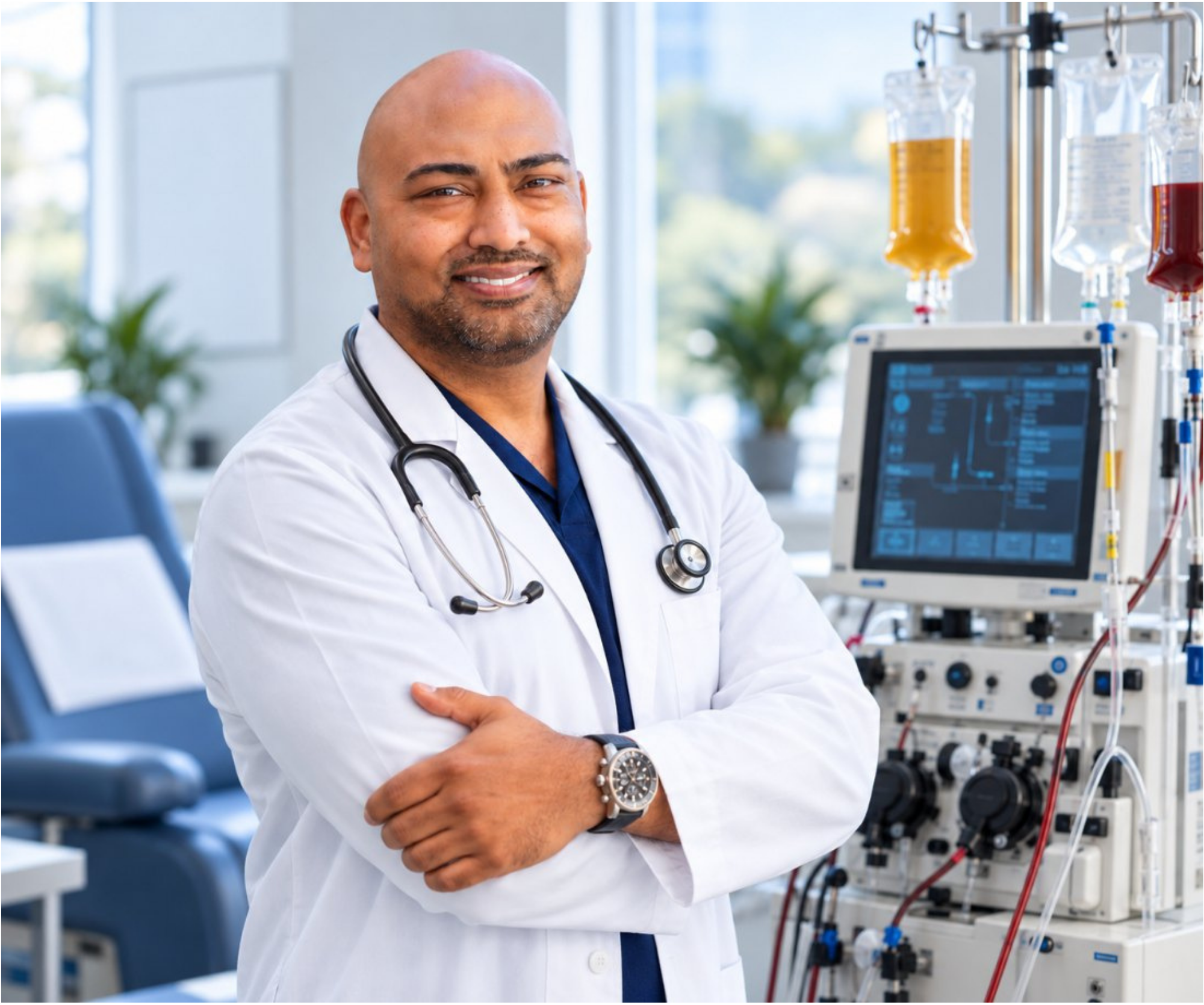
We will offer you this procedure when there is a reason to. We will tell you when there is not, and that answer costs you nothing but a conversation.
Plasma exchange is real medicine with sixty years of clinical use behind it. What is new is applying it to healthy adults for age related reasons, and that application rests on a small body of recent work that has not yet been independently replicated.
Both of those things are true at once. A clinic that tells you only the first is selling you history it did not earn. A clinic that tells you only the second has no business running the procedure at all. Our position is that you are capable of holding both, and that you should be given the information to decide rather than a conclusion to accept.
So the consultation comes first, the diagnostics come before the decision, and the decision has a defined point at which we look again and ask whether to continue. If the honest answer at any of those points is no, you will hear it.
Founder, Institute for Human Optimization · Longevity Gyms
What can happen, stated before you ask.
These are the reactions the manufacturer documents for automated apheresis. Most are mild, most are managed by adjusting the run rather than stopping it, and you should read the list rather than be surprised by it.
How this is actually arranged.
Longevity Gyms is a performance and recovery facility and does not provide medical care. Plasma exchange is ordered, supervised and reviewed by our physician team through the Institute for Human Optimization, from the first conversation to follow up.
Consultation
A physician reviews your history, medications and goals, and tells you plainly whether this is reasonable for you, including when it is not.
Diagnostics
Bloodwork and cardiovascular assessment confirm the procedure is safe for you and set a baseline. Bring recent labs and we will use them.
Decision and consent
Indication, alternatives, frequency, cost and risks are discussed in person, including what would make us stop.
The procedure
Two to three hours on the Spectra Optia, with clinical staff present throughout and a physician responsible for the order.
Review
Repeat markers where they are informative, measured against a plan agreed in advance, so more is never the default.
Questions answered.
What is therapeutic plasma exchange?
Blood is drawn, separated by centrifugation into its cellular components and its plasma, and the plasma is removed and replaced with a substitution fluid, most often albumin. Your red cells, white cells, and platelets are returned to you. Only the liquid fraction is exchanged.
Does plasma exchange reverse aging?
No study has shown that. A randomized trial published in Aging Cell in 2025 reported reductions in epigenetic age estimates in healthy adults over fifty. That trial was single blind, small, and funded by a company several of its authors are members of. Epigenetic age is an estimate derived from methylation patterns, not a measured outcome such as function, disease incidence, or lifespan.
How is this different from an IV drip or a cleanse?
Entirely different. An IV adds fluid and nutrients to circulation. Plasma exchange removes roughly a plasma volume and substitutes it. One is additive and low risk, the other is a prescription apheresis procedure requiring clinical supervision. We do not use the word cleanse for either.
How many sessions would I need?
For established clinical indications there are protocols. For age related use there is no established schedule, and anyone who quotes you one with confidence is going beyond the evidence. Your physician will propose a plan, explain the reasoning behind it, and define in advance the point at which it gets reassessed.
Does it hurt?
The needle placement is comparable to donating blood. The exchange itself is not painful. The most common sensation is tingling around the mouth or fingertips from the anticoagulant, which is managed during the session by adjusting the rate.
Who is not a candidate?
Anyone who cannot tolerate the fluid shifts involved, including people with unstable cardiac or renal disease, active infection, clotting disorders, poor venous access, or who are pregnant. Certain medications also interact with the procedure. This is decided at evaluation, not by questionnaire.
Is this covered by insurance?
For established clinical indications, often yes, through your own medical coverage. For elective age related use, generally not. Some diagnostics may be eligible for HSA or FSA reimbursement and we can provide documentation for submission.
Is it included in membership?
No. Plasma exchange is a clinical service with its own evaluation, its own consent process, and its own schedule. It sits alongside membership rather than inside a Circuit.
Therapeutic Plasma Exchange at a glance
Therapeutic plasma exchange separates blood into its cellular and liquid fractions, returns the cells, and replaces the plasma with a substitution fluid. At Longevity Gyms in Hanover, Maryland, it is performed on the Terumo BCT Spectra Optia Apheresis System under physician order and supervision through the Institute for Human Optimization.
- Spectra Optia
- Terumo BCT apheresis system
- Physician
- Prescribed and supervised
- Albumin
- Standard replacement fluid
- Evaluated
- Before anything is scheduled
Longevity Gyms · 7030 Hi Tech Drive, Suite 102, Hanover, MD 21076 · 410-858-4086 · Serving Baltimore, Columbia, Annapolis, BWI and the Washington DC corridor. Clinical oversight through the Institute for Human Optimization.
Reserve Your Consultation.
This begins with an evaluation rather than a booking. In it we will:
- Review your history, medications, and anything you have already measured
- Assess cardiovascular stability, renal function, and venous access
- Determine whether diagnostics are needed before any decision
- Tell you plainly whether plasma exchange is appropriate for you
- Explain the evidence, the risks, and what would make us stop
Hanover MD 21076, near BWI
410-858-4086
Read the Patient Guide (PDF)